Estimated time: 20 minutes · Goal: give three colours different roles and connect them with materials.
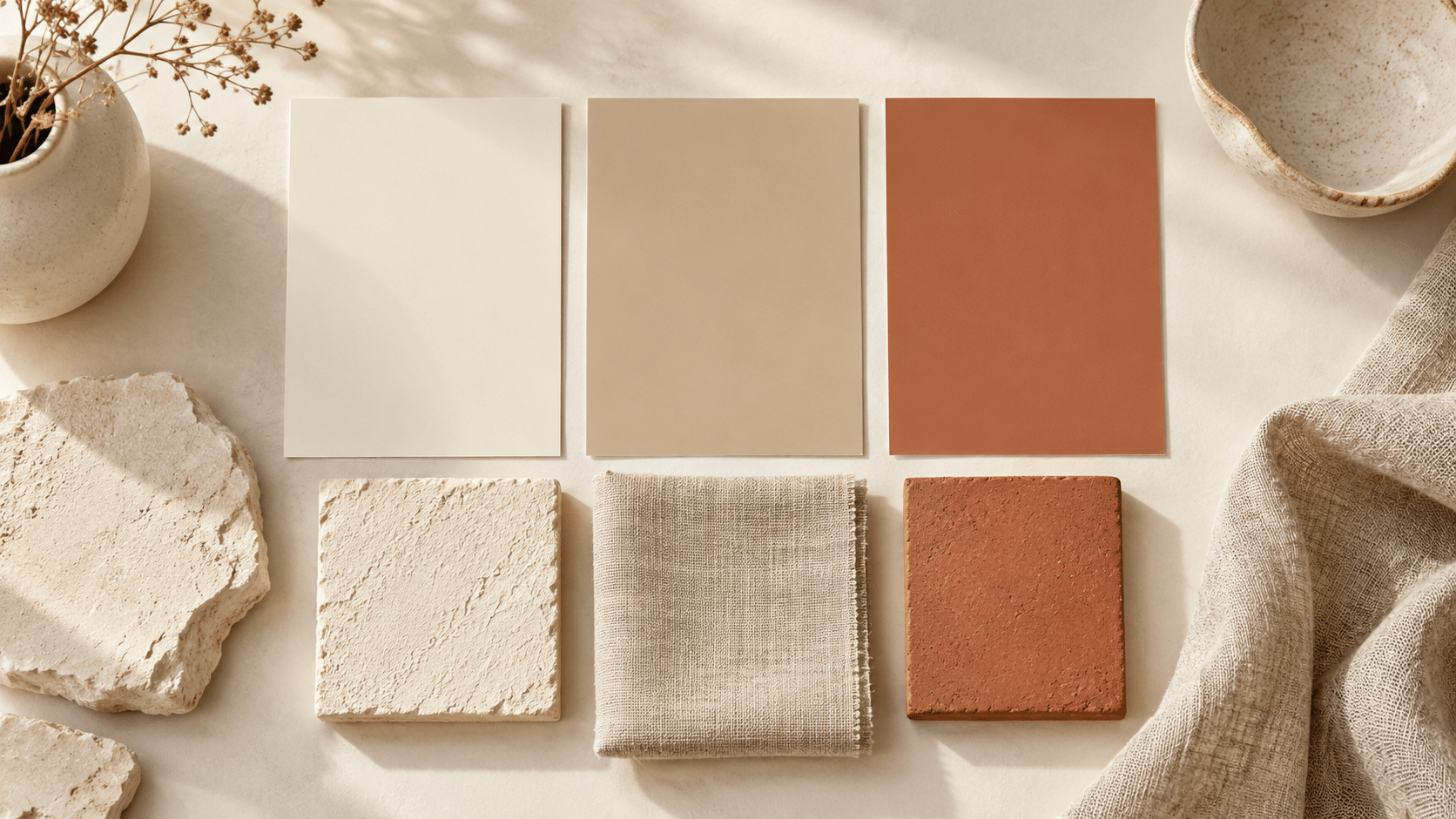
A palette assigns roles
Three colours do not mean three equally large areas. The base creates a broad, unifying background. A supporting colour connects the background with furniture or textiles. An accent creates a smaller, intentional emphasis. These names describe roles, not a required order of lightness: a dark base is possible too.
Try sketching proportions such as 60% base, 30% support and 10% accent. This is a starting aid, not a measurement rule. Consider the visible space as a whole: an existing colourful sofa may already supply the accent.
Look at the direction of a colour
Two whites can look different side by side: one more yellowish, another greyer. Ask whether the combination supports your mood words. A colour name alone cannot settle that question. Compare real samples beside the floor or furniture you will retain.
Connect colour and material
Repeating a colour through different textures can unify a space. Beside a smooth matt wall, a linen textile adds variation without a new main colour. Decide where a colour is used, then choose a surface that suits that use. Repeat a small accent in two places to make it feel intentional.
Worked example
- Base: warm white on a large wall area, creating a calm background.
- Support: sand in a linen cushion and curtain, connecting the background with a retained oak table.
- Accent: terracotta in a small pot and book cover, adding a controlled amount of warmth.
This is one reasoned solution, not the only correct combination. A retained blue sofa could equally be the starting point for a different palette.
Test before deciding
- Place your three samples together in the actual space, including the material you will retain.
- Look close up and from the entrance. A small sample does not establish the full effect of a large area.
- Compare daylight and your usual evening lighting. Record what you observe.
- Change one thing at a time, such as the supporting colour rather than all three.
- List care and suitability questions to check with the manufacturer. This course does not cover technical wet-room or structural design.
Exercise 2: your palette
For each colour, write its name, role, location and material texture. Explain in one sentence how the choice supports your mood words. Add one lighting observation and one possible change.
Common difficulties
Too much competition: reduce the area of one colour. The result feels flat: try a texture contrast before adding a fourth colour. The screen image and sample differ: decide using the sample in the real space.
Mark this lesson complete. The quiz checks these principles before you apply them in your design submission.